Cancer Awareness
Why Does Cancer Happen — And Why Is It So Complex?
If you are reading this page, you may have questions like:
Cancer is not just a single disease. It happens when the normal cells in our body stop following the natural rules that keep them healthy and controlled.Understanding cancer helps us reduce fear and make better health decisions.
In Your Body Cells are constantly dividing
Every second, millions of cells in your body divide and create new cells.
Cancer begins when the body’s natural control mechanisms break down.
- A cell that should stop dividing continues to multiply.
- A cell that should die persists.
- A cell that should remain in one place begins to spread.
Unlike bacteria or viruses, cancer is not an external invader. It arises from our own cells behaving abnormally — and that is what makes it uniquely challenging.
The Cancer Burden – Why It Matters Today
In India
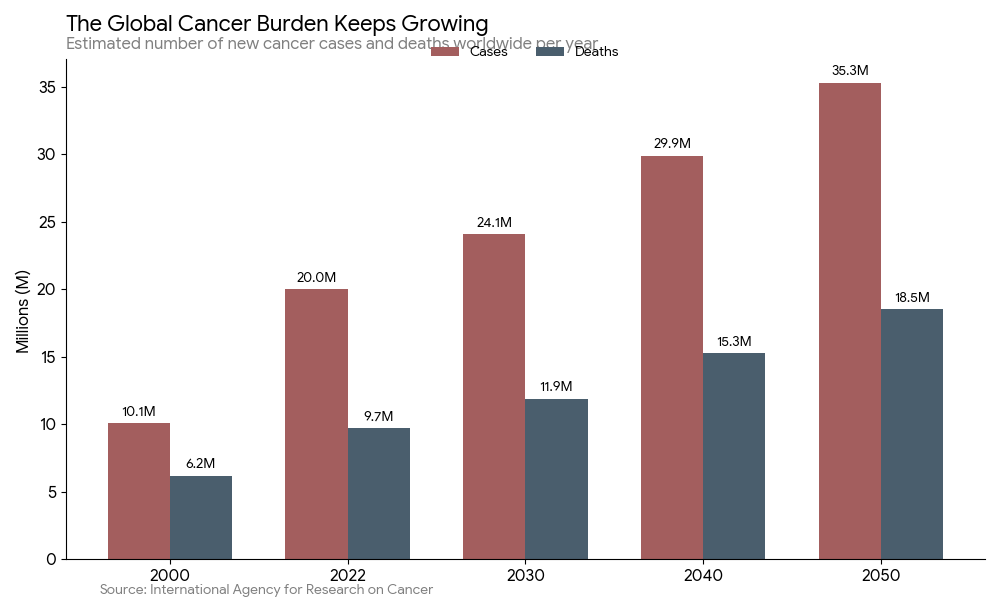
Data from the Indian Council of Medical Research and GLOBOCAN estimates show:
Cancer numbers are increasing mainly because:
-
Cancer is largely a disease of accumulated mistakes. Every time a cell divides, DNA must be copied. Over decades, small copying errors can occur. Usually, the body repairs these mistakes. Sometimes, it does not.By the age of 60 or 70, cells may have accumulated enough genetic damage to grow uncontrollably.That is why:
Aging is not the cause — but it increases probability.
-
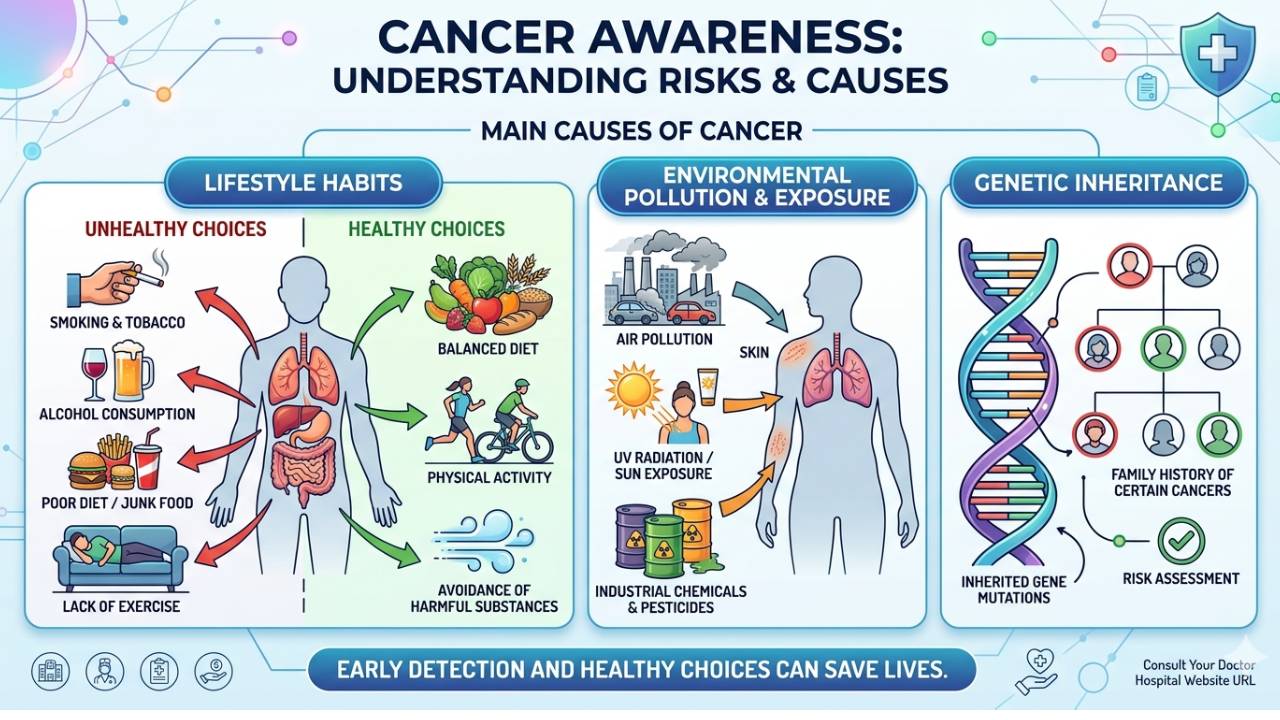
The honest answer is: both.
Genetic (Inherited) Causes
Only about 5–10% of cancers result from mutations passed down through families. These inherited mutations can increase risk, but they account for a small proportion of total cases.Acquired (Lifetime) Causes
Most cancers develop due to factors experienced over a lifetime, including:-
Tobacco exposure
-
Alcohol consumption
-
Obesity
-
Viral infections (such as HPV and Hepatitis B)
-
Radiation
-
Air pollution
-
Random DNA damage that accumulates over time
Cancer can be understood as the result of accumulated cellular stress that gradually disrupts normal biological control mechanisms.
-
Why Awareness Matters
Cancer does not usually begin with pain. It does not announce itself loudly in early stages. It begins as microscopic cellular change. Understanding : It helps people approach their health more consciously. Awareness reduces fear, and knowledge reduces delay.